One Founder, Many Companies: Why Agenticality Exists
The single-idea company is an artefact of expensive software. Here's the company we built for what comes after.
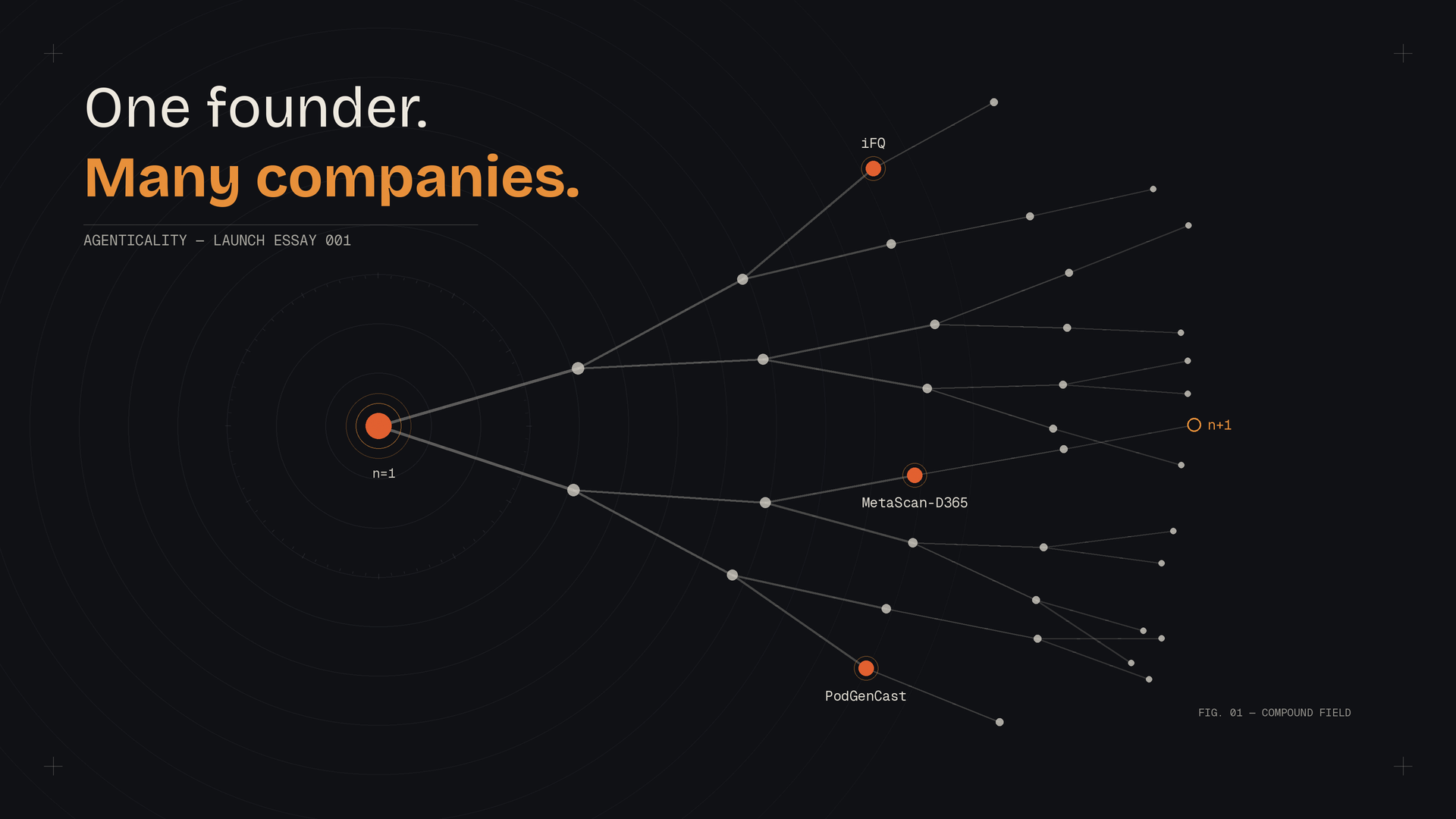
For two hundred years, the basic unit of business has been one company, one idea. You picked your bet, raised capital against it, hired against it, and lived or died by it. Not because focus was a virtue — because building was expensive. Every product needed its own engineers, its own operations, its own decade.
That constraint just broke. And almost nobody has updated their mental model.
The new physics of building
Three shifts define this moment, and we treat them as foundational at Agenticality:
Intelligence is no longer the bottleneck — attention is. When AI can draft, build, test, and ship, the constrained resource shifts from labour to human judgment. The scarce skill is deciding what deserves to exist, not making it exist.
Small teams now outcompete large ones. AI has quietly invalidated the assumptions behind hierarchy, process, and headcount. Communication overhead — the thing big organisations exist to manage — is exactly what agents eliminate. The organisations that adapt first will outcompete the ones optimised for the old physics.
Value is selection, not generation. In a world where anything can be produced, almost everything produced is noise. The rare, valuable act is picking the few combinations that matter — and having the taste to kill the rest.
Put those three together and you get a conclusion most of the market hasn't priced in yet: the single-idea company is an artefact of expensive software. When the cost of building collapses, the rational structure is not one bet — it's a disciplined portfolio of bets run by a small team with strong judgment.
That structure is Agenticality.
What we're building
Agenticality is a compound company: one foundation — shared infrastructure, shared design philosophy, shared distribution — and multiple products, each attacking a different recurring moment in everyday life where intelligence is wasted or value leaks.
iFQ — your financial headquarters. Most people make their most consequential decisions — money — with the least support. iFQ turns scattered accounts, currencies, and obligations into a single intelligent command centre, so financial judgment stops being a quarterly panic and becomes a daily habit.
MetaScan-D365 — licence optimisation for SaaS. Enterprises routinely pay for software capacity nobody uses. MetaScan scans Dynamics 365 estates and recovers that leakage — value that was always there, invisible until an agent went looking.
PodGenCast — written words, broadcast audio. Everything you write deserves to be heard. PodGenCast turns written content into broadcast-quality audio — and it demos itself on this very site: every essay in our Journal ships with a PodGenCast audio edition. Press play and you're watching the product work.
Every one of these is live, and none of them is finished — agents run the loop, so each is better this week than it was last week. And they aren't three startups in a trench coat. They share one belief: AI's real economic gift is not doing new things — it's stopping the waste of what we already have. Wasted licences. Wasted financial insight. Wasted hours. Humanity doesn't need ten times more resources to do ten times more; it needs intelligence applied to the resources already in motion. That's the "do more with what exists" dividend, and it's the largest under-exploited market in the world because it hides inside everyone's ordinary day.
How we decide what to scale
Our filter is simple and brutal: value per day, per person.
An idea earns investment at Agenticality only if it touches a loop someone runs daily or weekly — managing money, managing software spend, consuming and creating content — and only if an agent measurably improves that loop within the first session. No grand platforms that pay off in year three. Daily value compounds; everything else decays.
This is also why the portfolio shape matters. Each product is a sensor. iFQ teaches us how individuals trust agents with money. MetaScan teaches us how enterprises trust agents with spend. Every product makes the next one cheaper to build and smarter on day one — shared agents, shared learnings, shared customers whose lives we already sit inside.
Why this compounds
The obvious objection is focus. Our answer: focus didn't disappear — it moved up a level. We are ruthlessly focused, just not on a single product; we're focused on a single capability — agentic judgment applied to daily loops — expressed across three uncorrelated markets. One correlated capability, three uncorrelated markets: diversification without dilution.
If you evaluate Agenticality as a portfolio of small apps, you'll misprice it. The right comparison is the early venture studio — except where studios spun out separate companies because building was expensive, we keep everything compounding under one roof because building no longer is.
The asymmetry investors should see: our marginal cost of launching product N+1 keeps falling, while the value of our shared judgment layer — knowing which daily loops convert, what people will trust agents to do, where value leaks — keeps rising. Single-product companies have one shot at product-market fit. A compound company has a repeatable process for product-market fit. In the age of AI, the process is the moat.
One more thing the market keeps underestimating: this is all sitting on an exponential curve, and exponentials punish anyone who plans linearly. A company structured for one idea is a linear plan. Agenticality is structured for the curve.
The bigger claim
This is not just a company strategy. It's a claim about what AI is for.
The pessimistic story says AI replaces people. The lazy optimistic story says AI makes everything cheap. The interesting story — the one we're betting the company on — is that AI lets a small number of humans apply judgment across far more of life than was ever possible, recovering value that was always there but never worth the effort to capture.
One founder used to mean one idea. Now it means a portfolio. One business used to mean one market. Now it means every daily loop you're disciplined enough to improve.
We're building Agenticality to prove that the constraint was never ambition, capital, or even intelligence.
It was the cost of trying. And that cost just went to zero.
Agenticality builds agent-powered products for the loops you live every day. Follow along — there's more shipping soon.