Medicine Becomes a Loop
AI diagnosing better than doctors is the boring prediction. The real shift: your health stops being an annual event and becomes a standing process.
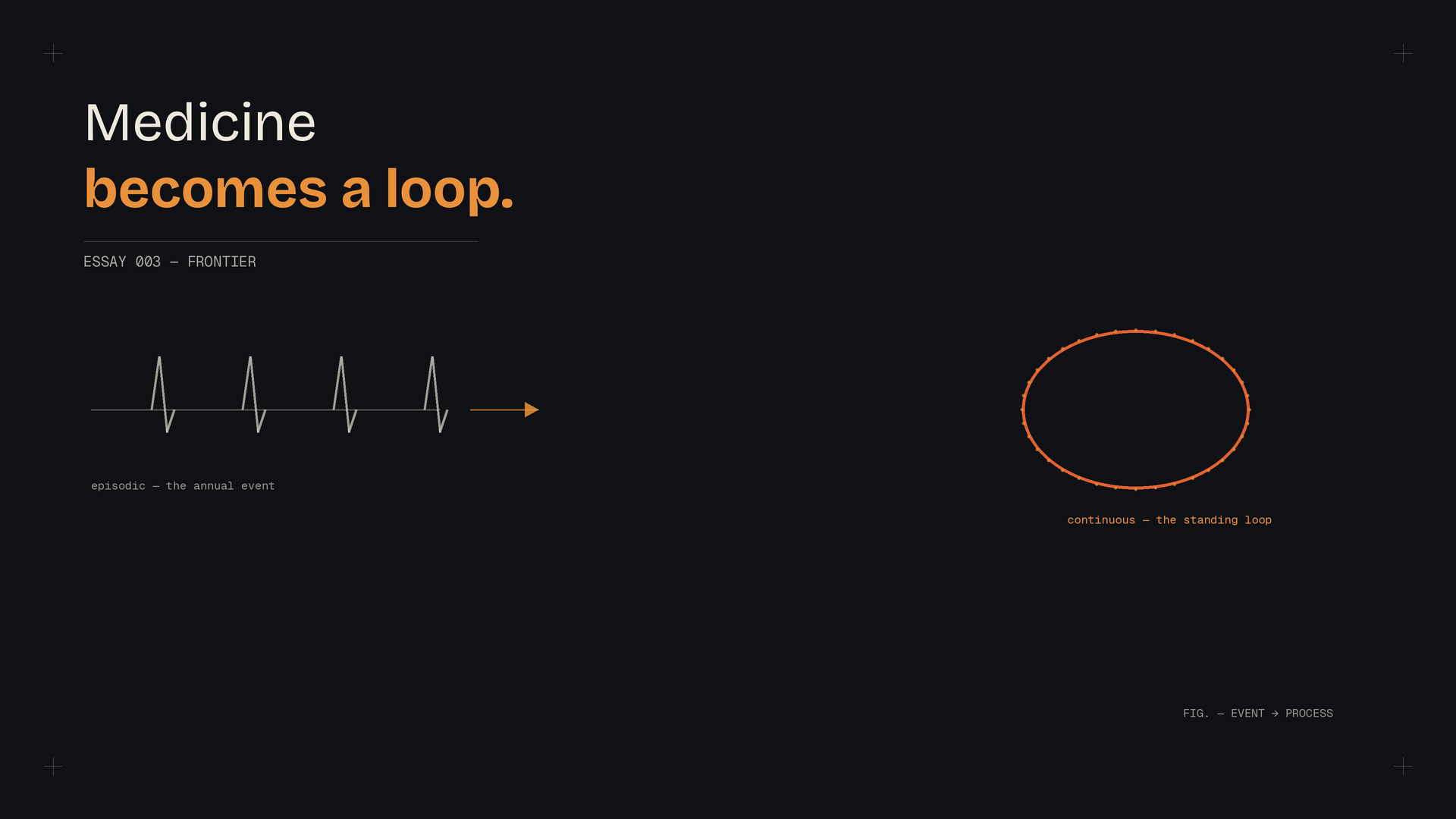
The prediction everyone makes about AI in medicine — that machines will out-diagnose doctors — is already coming true and is almost beside the point. Diagnosis occupies a few minutes of your life, a handful of times. The thing that actually determines your health span occupies the other 8,759 hours a year, when no clinician is watching.
That's the hour AI just changed.
Medicine is episodic because attention was scarce
Step back and ask why healthcare looks the way it does: annual checkups, fifteen-minute consults, treatment that begins after symptoms announce themselves. None of this is medically optimal. It's economically inevitable — clinician attention is brutally scarce, so the system rations it into episodes and waits for problems to grow loud enough to justify a slot.
Every chronic disease tells the same story: years of quiet, measurable drift, invisible between appointments, until the drift becomes an event. We built a medical system that is excellent at events and structurally blind to drift.
Agents end the scarcity that made this rational. A standing process can watch the drift — the bloodwork trends, the sleep decay, the medication adherence, the silent kilogram a quarter — every single day, at a marginal cost near zero, and escalate to a human precisely when human judgment is worth its price. Medicine becomes a loop, and the loop catches what the event never could.
What stays human, and what stays slow
Honesty about the bottlenecks the popular story skips: intelligence compresses the thinking in medicine, not the proving. Trials still take years because biology takes years. Liability still demands a human signature because accountability cannot be delegated to a process that can't be sued. And regulation — rightly — moves at the speed of caution, not the speed of compute.
So the constraint on the loop revolution isn't capability. It's institutional design: who licenses a standing care process, who answers when it errs, how a regulator audits software that never stops practising. These are solvable problems, but they are policy problems, and policy is now the rate-limiter of health outcomes.
Which yields a bold and uncomfortable prediction: the first country to license agentic care loops — with real accountability architecture — buys itself a decade of health outcomes its peers will spend twenty years envying. The medicine is ready. The question is which health system updates its constitution first.
The future of healthcare isn't a smarter fifteen minutes. It's the end of the fifteen minutes as the unit of care — and the beginning of health as something that is continuously, quietly, relentlessly attended.
Diagnosis was never the bottleneck. Attention was. And attention just became abundant.